
Explain Nutrient Interaction: Your Practical Health Guide


TL;DR:
Nutrient interactions influence absorption, metabolism, and bioavailability, affecting how body nutrients are utilized. Timing, food pairing, and supplement separation are essential to optimize nutrient bioavailability and avoid deficiencies. Using tracking tools like Bimiapp helps individuals manage these relationships effectively in daily nutrition planning.
Nutrient interaction is defined as the effect one nutrient has on the absorption, metabolism, or excretion of another nutrient in the body. This process directly changes bioavailability, which is how much of a nutrient your body actually uses versus what you consume. You can eat a diet rich in iron and still develop a deficiency if calcium, tea polyphenols, or phytates are blocking absorption at every meal. Understanding these relationships is the foundation of effective nutrition planning, and tools like Bimiapp make it practical to track them daily.
How do nutrients interact at the absorption and metabolic level?

Nutrient interactions are best understood as changes in absorption, metabolism, or excretion when one nutrient affects another’s bioavailability. The gut is where most of these interactions happen. Nutrients compete for the same intestinal transport proteins, block each other’s solubility, or enhance each other’s chemical form for uptake.
Competition for transporters
Calcium and iron share overlapping intestinal transport pathways. When both are present in high amounts at the same time, calcium wins the competition. The result is reduced iron uptake, regardless of how much iron you consumed.
Zinc and iron follow a similar pattern. A 5:1 zinc-to-iron ratio in an aqueous solution reduces iron absorption by 56%. That number drops significantly when both minerals are taken with food rather than on an empty stomach.
Enhancement and inhibition mechanisms
Vitamin C converts ferric iron (Fe³⁺) into ferrous iron (Fe²⁺), the form the gut absorbs more easily. This keeps iron soluble in the intestinal environment and raises non-heme iron absorption at a single meal. Heme iron, found in meat, uses a separate transporter and is largely unaffected by this mechanism.
Polyphenols and phytates work in the opposite direction. Polyphenols in tea bind ferric iron directly, forming complexes the gut cannot absorb. Phytates in whole grains and legumes do the same. Both are common in healthy diets, which is why absorption context matters as much as nutrient content.
Interaction type | Mechanism | Example |
Competitive inhibition | Shared transporter | Calcium blocks iron |
Chemical enhancement | Converts to absorbable form | Vitamin C + non-heme iron |
Binding inhibition | Forms insoluble complex | Polyphenols + iron |
Dose-dependent inhibition | Ratio-driven competition | Zinc + iron at high doses |
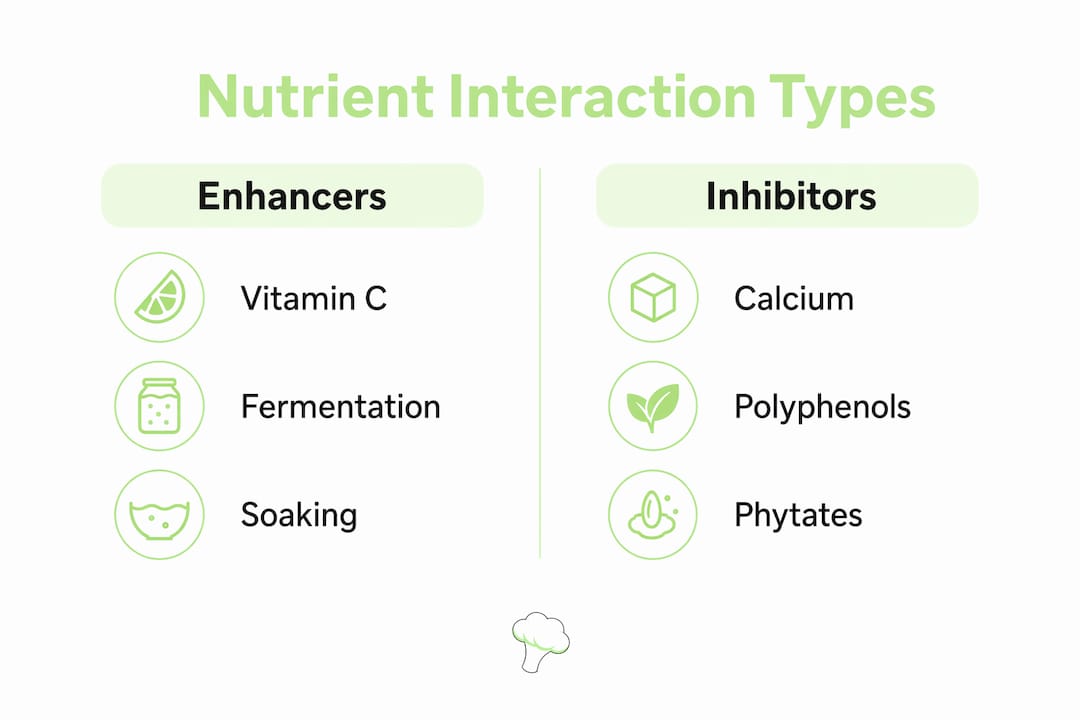
Pro Tip: Processing methods like fermentation, soaking, and sprouting reduce phytate content in grains and legumes, which directly improves mineral absorption without changing the food’s nutrient profile.
What are the major nutrient interactions with examples?
The most clinically studied nutrient interactions center on iron because non-heme iron is highly sensitive to both enhancers and inhibitors. Heme iron, by contrast, absorbs through its own dedicated transporter and resists most dietary interference. This distinction matters for anyone eating a plant-based diet or managing iron deficiency.
Calcium and iron
Calcium cuts non-heme iron absorption by 50–60% at supplemental doses. That is one of the strongest inhibitory effects documented between two common supplements. Taking both at the same time is a straightforward way to undermine an iron supplement’s effectiveness.
The fix is simple: space calcium and iron supplements by at least two hours. This timing separation removes the competition entirely and restores normal iron absorption.
Vitamin C and iron
Vitamin C is the most well-documented absorption enhancer for non-heme iron. It maintains iron in its soluble, absorbable form throughout the digestive process. The effect is strongest at a single meal and less pronounced when measured across weeks of consistent intake.
Pairing a vitamin C source like bell pepper, citrus, or broccoli with plant-based iron foods is a practical and cost-free strategy. No supplement required.
Tea polyphenols and iron
Tea polyphenols can reduce non-heme iron absorption by 60–90% when consumed with an iron-rich meal. That is a dramatic reduction from a beverage most people consider healthy. Coffee produces a similar effect through chlorogenic acids.
Drinking tea one to two hours after a meal, rather than with it, reduces this inhibition substantially. The polyphenols are still present, but they no longer encounter iron in the gut at the same time.
Key nutrient pairs at a glance
Nutrient pair | Interaction effect | Practical tip |
Calcium + iron | Calcium inhibits iron absorption 50–60% | Separate by 2+ hours |
Vitamin C + non-heme iron | Vitamin C enhances iron absorption | Pair at the same meal |
Tea polyphenols + iron | Reduces absorption by 60–90% | Drink tea 1–2 hours after meals |
Zinc + iron (supplements) | High zinc-to-iron ratio inhibits iron | Take with food or space by 1–2 hours |
Phytates + minerals | Binds iron, zinc, calcium | Soak or ferment grains and legumes |
Non-heme iron is the form found in plant foods, eggs, and fortified products.
Heme iron from meat and fish is largely unaffected by calcium, polyphenols, or phytates.
Vitamin C has no measurable effect on heme iron absorption.
Zinc and iron competition is dose-dependent and mostly relevant for supplements, not food.
How does timing and context affect nutrient interaction outcomes?
Timing is the most underused tool in practical nutrition. Most people focus on what they eat but ignore when they take supplements relative to meals and each other. The chemical form, dose, and meal context of a nutrient determine whether an interaction is clinically meaningful or negligible.
Separate competing supplements. Space calcium and iron by at least two hours. Supplement timing separation is one of the most effective real-world fixes for absorption competition. The same principle applies to zinc and iron when taken in supplement form.
Take iron supplements on an empty stomach when tolerated. Absorption is highest without food. If stomach discomfort is an issue, take iron with a small amount of food but avoid calcium-rich foods, tea, or coffee at the same sitting.
Use food matrix effects to your advantage. Fermented, soaked, or sprouted grains and legumes contain fewer phytates. This means the iron and zinc in those foods are more available to your body. Food preparation is a legitimate absorption strategy.
Account for your current nutrient status. People with iron deficiency absorb non-heme iron more aggressively than those with adequate stores. Standard RDAs do not account for this variability, which means personalized consideration is essential in nutrition planning.
Log your meals and supplements together. Bimiapp tracks over 60 nutrients and lets you review your intake patterns across time. Seeing your calcium and iron intake on the same timeline makes timing conflicts visible and easy to fix.
Pro Tip: If you take a multivitamin containing both calcium and iron, check the dose of each. Low-dose combinations in food-based multivitamins may not produce clinically significant competition, but high-dose single-nutrient supplements almost always do.
What practical steps can you take to optimize nutrient interactions?
Applying knowledge about nutrient absorption relationships does not require a dietitian or a complicated schedule. A few consistent habits produce most of the benefit.
Pair plant-based iron with vitamin C at every meal. Add lemon juice to lentil soup, eat bell peppers with spinach, or drink orange juice with fortified cereal. This single habit meaningfully raises non-heme iron absorption.
Move tea and coffee away from meals. Drink them at least one hour before or after eating iron-rich foods. This reduces polyphenol-driven inhibition without eliminating the beverages from your diet.
Space your supplements deliberately. Take calcium in the evening and iron in the morning, or separate them by two or more hours. The same rule applies to zinc and iron supplements taken on an empty stomach.
Check your micronutrient intake regularly. Deficiency changes how strongly interactions affect you. Someone low in iron absorbs it more readily, but also suffers more from inhibitors. Monitoring your status helps you know when to be strict about timing.
Use Bimiapp to identify patterns. Bimiapp’s AI-driven food recognition and nutrient tracking let you log meals by photo, review your intake of over 60 nutrients, and spot recurring gaps or conflicts. If your calcium intake consistently peaks at the same time as your iron intake, Bimiapp makes that visible.
Reduce phytates through preparation. Soak beans overnight, sprout lentils, or choose fermented grain products. These steps lower the phytate load and improve mineral availability across the whole meal, not just for iron.
The goal is not perfection. Small, consistent changes in pairing and timing produce real improvements in nutritional balance over weeks and months.
Key Takeaways
Nutrient interactions alter bioavailability through competition, enhancement, and binding, making timing and food pairing as important as total nutrient intake.
Point | Details |
Bioavailability over content | Eating enough of a nutrient does not guarantee absorption if inhibitors are present. |
Calcium and iron conflict | Calcium reduces non-heme iron absorption by 50–60%; separate supplements by 2+ hours. |
Vitamin C as an enhancer | Pairing vitamin C with plant-based iron at the same meal raises absorption significantly. |
Tea timing matters | Polyphenols in tea cut iron absorption by up to 90%; drink tea 1–2 hours after iron-rich meals. |
Track to act | Bimiapp monitors over 60 nutrients and helps identify timing conflicts in your daily intake. |
Why I think most people are solving the wrong nutrient problem
Most nutrition advice focuses on what to eat. Add more iron. Take more calcium. Eat more leafy greens. That framing misses the point entirely. The real question is not what you consume but how much your body actually absorbs and uses.
I have seen people supplement iron for months with no improvement in their levels, only to discover they were washing it down with a calcium supplement every morning. The interaction was obvious in hindsight. But without tracking both nutrients on the same timeline, it was invisible.
The other thing people underestimate is how much individual status changes the picture. Someone with adequate iron stores and someone with iron deficiency respond very differently to the same inhibitors. A blanket rule like “avoid tea with meals” is useful, but it matters far more for a person who is already depleted. Context is everything.
Tools like Bimiapp exist precisely for this reason. Tracking nutrient intake patterns over time, across 60-plus nutrients, gives you the data to see interactions before they become deficiencies. That is a fundamentally different approach from guessing based on general guidelines.
The uncomfortable truth is that standard RDAs were not designed with absorption variability in mind. They assume average conditions. Your conditions are not average. Personalized tracking is not a luxury. It is the only way to know whether your nutrition plan is actually working.
— Alvi
Bimiapp and nutrient interaction tracking
Knowing how nutrients interact is only useful if you can apply it to your actual diet. Bimiapp connects that knowledge to your daily intake.
Bimiapp tracks over 60 nutrients, including iron, calcium, zinc, vitamin C, and key minerals, across every meal you log. Its AI food recognition lets you capture meals by photo, estimate portions, and see your full nutrient breakdown instantly. The Meals Vault stores your history so you can review timing patterns and spot recurring conflicts. Personalized recommendations adjust based on your age, weight, BMI, and activity level. Check how Bimiapp works and start logging your meals with nutrient interaction in mind.
FAQ
What is a nutrient interaction?
A nutrient interaction occurs when one nutrient affects the absorption, metabolism, or excretion of another. The result is a change in how much of that nutrient your body actually uses.
Why does calcium block iron absorption?
Calcium and non-heme iron compete for the same intestinal transporters. At supplemental doses, calcium reduces iron absorption by 50–60%. Spacing them by at least two hours eliminates most of this competition.
Does vitamin C help with all types of iron absorption?
Vitamin C enhances non-heme iron absorption by keeping iron in its soluble form in the gut. It has no measurable effect on heme iron, which uses a separate transport pathway.
How much does tea reduce iron absorption?
Tea polyphenols can reduce non-heme iron absorption by 60–90% when consumed with an iron-rich meal. Drinking tea one to two hours after eating substantially lowers this inhibitory effect.
How can I track nutrient interactions in my diet?
Bimiapp monitors over 60 nutrients across your meals and supplements, making it possible to identify timing conflicts and absorption risks in your actual daily intake pattern.
Recommended
Comments