
The Role of Food Synergy in Boosting Nutrient Absorption


TL;DR:
Eating specific food combinations enhances nutrient absorption and boosts health benefits beyond individual foods. Using patterns like pairing turmeric with black pepper or combining eggs with vegetables can significantly increase bioavailability of key nutrients. Tools like Bimiapp help track these synergies and improve dietary choices for better health outcomes.
Food synergy is defined as the measurable increase in nutrient absorption and health benefits that occurs when specific foods are eaten together rather than separately. This concept goes beyond basic nutrition tracking. It explains why a spinach salad topped with olive oil delivers far more usable nutrients than spinach eaten plain. The role of food synergy is central to how modern nutrition science now approaches dietary planning. Classic examples include turmeric paired with black pepper, and carotenoid-rich vegetables eaten with healthy fats. Bimiapp tracks over 60 nutrients and helps you apply these principles to your actual meals, not just theory.
How does food synergy enhance nutrient absorption?
Food synergy works through a mechanism called the food matrix effect. Nutrients inside whole foods are embedded in complex cellular structures that regulate how fast and how completely your body absorbs them. This is why an isolated vitamin C supplement behaves differently in your body than vitamin C from a fresh orange eaten alongside iron-rich lentils.

The food matrix concept shifts nutrition science away from isolated nutrient thinking toward system-based interactions. Fat-soluble vitamins like A, D, E, and K require dietary fat to cross the intestinal wall. Without fat present in the same meal, your body absorbs only a fraction of what those foods contain. Carotenoids absorb better when cooked or eaten with oils like olive oil. This is nutrient absorption synergy in action.
Piperine, the active compound in black pepper, works differently. It inhibits enzymes in the gut and liver that would otherwise break down curcumin before it reaches the bloodstream. The result is dramatically higher bioavailability from the same amount of turmeric. Vitamin C enhances plant-based iron absorption by converting ferric iron into ferrous iron, the form your intestines can actually absorb.
Pro Tip: Whole food combinations consistently outperform supplements for synergy. A supplement delivers an isolated compound. A whole food delivers that compound surrounded by co-factors, fiber, and enzymes that work together to get it into your cells.
What are the best-proven synergistic food combinations?
The most documented food pairing benefit in nutrition research is turmeric with black pepper. Curcumin absorption increases by over 2,000% when piperine from black pepper is present. That number is not a rounding error. A pinch of black pepper in a turmeric latte or curry transforms a mildly bioavailable compound into one your body can actually use.
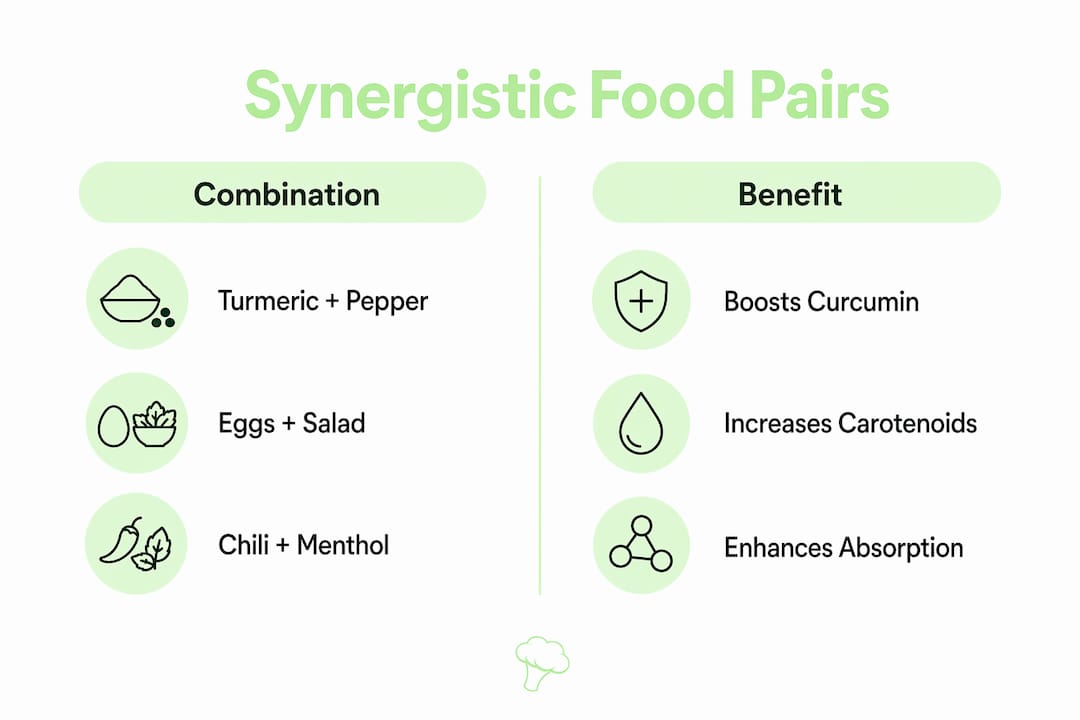
Eggs with salad produce a similar effect. Eating 3 whole eggs alongside a vegetable salad boosts carotenoid absorption up to eight-fold compared to eating the salad alone. The fat and protein in the egg yolk create the absorption environment that carotenoids need. Skipping the egg and using fat-free dressing leaves most of those antioxidants unabsorbed.
Spice combinations show some of the most striking results. Combining capsaicin from chili peppers with menthol or 1,8-cineole from herbs produces anti-inflammatory effects several hundred-fold greater than either compound alone. Cooking tomatoes with olive oil increases lycopene bioavailability because heat breaks down cell walls and fat carries the lycopene into your system.
Food Combination | Nutrient Effect | Outcome vs. Eating Separately |
Turmeric + black pepper | Curcumin absorption | Over 2,000% increase |
Eggs + vegetable salad | Carotenoid absorption | Up to 8-fold increase |
Capsaicin + menthol | Anti-inflammatory effect | Several hundred-fold greater |
Tomatoes + olive oil | Lycopene bioavailability | Significantly higher |
Vitamin C foods + iron foods | Iron absorption | Ferric converted to absorbable ferrous form |
The table above shows why food combinations health outcomes differ so sharply from eating the same foods in isolation. The gains are not marginal. They are transformational.
How does food synergy fit into a balanced diet?
Food synergy is a flexible dietary framework, not a rigid set of rules you must follow at every meal. The goal is to build patterns over time that naturally include synergistic pairings. Stressing over every bite defeats the purpose.
Traditional cuisines figured this out long before modern nutrition science named it. Legumes paired with grains complete each other’s amino acid profiles, providing all essential amino acids that neither food delivers alone. Mexican rice and beans, Indian dal with roti, and Japanese miso soup with rice all encode synergy principles developed over centuries of practical cooking. These cultures were enhancing nutrition with food synergy without a lab to confirm it.
Practical ways to build synergy into your daily meals:
Add a drizzle of olive oil or a slice of avocado to any salad with leafy greens or tomatoes
Pair lentils, chickpeas, or black beans with a grain like brown rice or whole wheat bread
Add a squeeze of lemon or a serving of bell pepper to any iron-rich plant meal
Use black pepper in any turmeric-containing dish, including soups, curries, and smoothies
Cook tomatoes in olive oil rather than eating them raw for maximum lycopene uptake
Bimiapp makes this practical. The platform tracks over 60 nutrients and shows you which meals are delivering strong nutrient coverage and which ones have gaps. You can log meals using photo recognition, check your nutrient intake patterns, and spot where a simple pairing adjustment could improve your results.
Pro Tip: You do not need to redesign your entire diet. Pick two or three synergistic pairings that fit your current eating habits and build from there. Consistency with a few good combinations beats perfection with a complex system.
What health benefits come from practicing food synergy?
Regular practice of synergistic eating produces measurable improvements across several health markers. The most direct benefit is improved antioxidant status. When carotenoids, lycopene, and polyphenols are properly absorbed, they neutralize free radicals more effectively. Poor absorption means those compounds pass through your system without doing their job.
Anti-inflammatory outcomes improve significantly with the right food combinations. The spice synergy research showing several hundred-fold increases in anti-inflammatory effect has direct implications for chronic disease prevention. Persistent low-grade inflammation connects to cardiovascular disease, type 2 diabetes, and metabolic syndrome. Eating combinations that amplify anti-inflammatory compounds addresses that risk at the dietary level.
Key health outcomes linked to consistent synergistic eating include:
Stronger immune function from better absorption of vitamins A, C, D, and E
Improved metabolic health through complete amino acid intake and better mineral absorption
Reduced inflammation from amplified polyphenol and spice compound effects
Better weight management because well-absorbed nutrients reduce cravings driven by deficiency
Lower chronic disease risk through sustained antioxidant and anti-inflammatory activity
The nutritional analysis methods used by platforms like Bimiapp help you connect these outcomes to your actual intake data. Seeing your nutrient trends over time makes it possible to identify which combinations are working and which gaps remain.
Key Takeaways
Food synergy is the most underused tool in practical nutrition: specific food combinations multiply nutrient absorption and health benefits far beyond what any single food delivers alone.
Point | Details |
Food synergy definition | Paired foods increase nutrient absorption and health outcomes beyond their individual effects. |
Top proven pairing | Turmeric with black pepper raises curcumin absorption by over 2,000%. |
Fat activates key nutrients | Fat-soluble vitamins and carotenoids require dietary fat in the same meal to absorb properly. |
Flexible framework | Synergy works as a dietary pattern over time, not a rule applied to every single meal. |
Track your intake | Bimiapp monitors over 60 nutrients to show where synergistic pairings improve your results. |
Why I think most people are missing the biggest nutrition win available to them
Most people chasing better health focus on what to eat. They count calories, track macros, or eliminate food groups. Very few focus on how foods interact with each other. That gap is where the real opportunity sits.
I have watched people take high-quality supplements and still show deficiency markers because the co-factors needed for absorption were missing from their diet. The supplement was real. The absorption was not. That experience made the food matrix concept click for me in a way that no textbook explanation did.
The other mistake I see is treating synergy as an all-or-nothing system. You do not need to rebuild your diet around pairing charts. You need two or three reliable combinations that fit your lifestyle. Eggs on your salad. Black pepper in your turmeric dishes. Lemon juice on your lentils. Those three habits alone cover a significant portion of what synergy research recommends.
Tools like Bimiapp make this less abstract. When you can see your actual nutrient data across 60 categories, the gaps become obvious. You stop guessing and start making specific adjustments. That is the difference between reading about bio-optimization strategies and actually applying them.
Synergy is not a trend. It is how food has always worked. Modern nutrition science is just now catching up to what traditional cuisines encoded for centuries.
— Alvi
How Bimiapp helps you apply food synergy every day
Bimiapp is built for people who want their nutrition data to mean something. The platform tracks over 60 nutrients, including fat-soluble vitamins, carotenoids, amino acids, and minerals, so you can see exactly which synergistic combinations are working in your diet.

Capture a meal with your phone, and Bimiapp’s AI identifies the foods, estimates portions, and analyzes nutrient content in seconds. You can check whether your salad has enough fat to absorb its carotenoids, or whether your plant-based meals are pairing iron with vitamin C. The Meals Vault stores your data locally so you can review trends and generate reports over time. Start applying food synergy with real data behind you. See how it works and take the guesswork out of your nutrition today.
FAQ
What is food synergy in simple terms?
Food synergy is when two or more foods eaten together produce greater nutrient absorption or health benefits than either food delivers alone. The classic example is turmeric with black pepper, which increases curcumin absorption by over 2,000%.
How does food synergy work biologically?
The food matrix in whole foods regulates how nutrients are digested and absorbed. Certain compounds like piperine block enzymes that break down other nutrients, while dietary fats carry fat-soluble vitamins and carotenoids across the intestinal wall.
What are the easiest synergistic food combinations to start with?
Add olive oil or avocado to any salad, pair lentils with whole grains, and use black pepper in any turmeric dish. These three pairings cover fat-soluble vitamin absorption, complete protein intake, and curcumin bioavailability.
Does cooking affect food synergy?
Cooking tomatoes with olive oil increases lycopene bioavailability because heat breaks down cell walls and fat enables absorption. Some synergistic effects improve with heat, while others, like vitamin C paired with iron, work best with raw or lightly cooked foods.
Can Bimiapp help me track food synergy?
Bimiapp tracks over 60 nutrients and uses AI photo recognition to analyze your meals. You can monitor fat-soluble vitamin intake alongside dietary fat consumption and identify gaps where a simple food pairing adjustment would improve your nutrient absorption.
Recommended
Comments